
Choosing the right laptop display matters more than ever. With manufacturers pushing OLED panels into mainstream laptops while LCD continues to dominate budget and productivity devices, buyers often ask the same question:
In this guide, we break down OLED vs LCD laptop displays in 2026, covering picture quality, battery life, durability, price, and which users benefit most from each technology.
What Is an OLED Laptop Display?
OLED (Organic Light-Emitting Diode) displays use self-emitting pixels, meaning each pixel produces its own light. Unlike LCD screens, OLED panels do not require a backlight.
OLED Advantages
- True blacks and infinite contrast
- Extremely vibrant colors
- Faster pixel response times
- Thinner display panels
OLED Drawbacks
- Higher cost
- Potential burn-in (less common on modern panels)
- Slightly higher power usage at high brightness
OLED displays are now common in premium ultrabooks, creator laptops, and high-end gaming models.
What Is an LCD Laptop Display?
LCD (Liquid Crystal Display) screens rely on a backlight, usually LED-based, to illuminate pixels. This technology has been refined for decades and remains the most widely used display type in laptops.
LCD Advantages
- Lower cost
- Excellent brightness for outdoor use
- No burn-in risk
- Better battery life in many scenarios
LCD Drawbacks
- Weaker contrast compared to OLED
- Blacks appear grayish
- Slower response times on cheaper panels
Most budget, business, and mid-range laptops still use LCD panels.
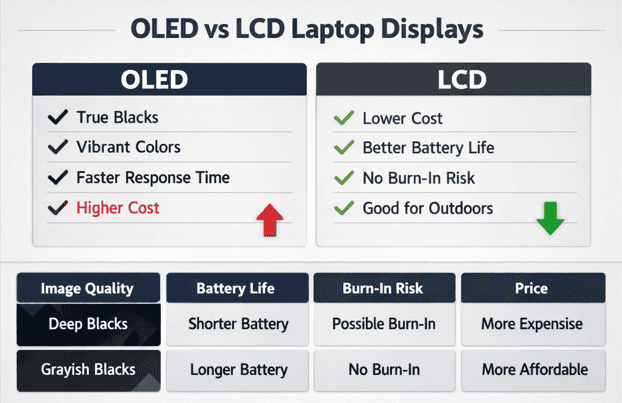
OLED vs LCD: Key Differences
Image Quality
OLED clearly wins in contrast and color accuracy. Blacks are truly black, making movies and photos look stunning. LCD panels, especially IPS displays, still look good but can’t match OLED depth.
Battery Life
LCD displays usually consume less power during typical productivity tasks. OLED can be more efficient when displaying dark content but drains more battery at high brightness.
Burn-In Concerns
Modern OLED laptops use pixel shifting and screen refresh technologies to reduce burn-in. While still possible, it’s far less common than in early OLED panels.
Price
OLED laptops typically cost $150–$400 more than comparable LCD models.
Which Display Is Better for You?
Choose OLED If You:
- Edit photos or videos
- Watch a lot of movies
- Want the best possible visuals
- Prefer premium laptop designs
Choose LCD If You:
- Want longer battery life
- Work mostly with documents and browsers
- Need a more affordable laptop
- Use your laptop outdoors frequently
OLED vs LCD in 2026: Final Verdict
OLED displays deliver unmatched image quality and are ideal for creators and media lovers. However, LCD remains the better value for most users due to lower cost, longer battery life, and reliability.
For laptop buyers in 2026, the best display depends on how you actually use your laptop, not just the specs on paper.